
In the world of luxury watches, there are countless models with stories to tell — tales of deep-sea diving, motorsport glory, and space travel. But few stories are as unexpected, quirky, and charming as that of the Domino’s Rolex. This unusual collaboration between one of the world’s most prestigious Swiss watchmakers and a fast-food pizza chain created a piece of corporate history that has since transformed into a collector’s gem.
The concept began in the late 1970s with Domino’s Pizza founder Tom Monaghan, who had a flair for motivating his franchisees with creative rewards. Initially, managers who hit certain sales goals were awarded watches from brands like Seiko or Bulova. But as Domino’s grew rapidly and its brand image became more ambitious, Monaghan decided to make the reward truly memorable — upgrading it to a Rolex. The idea was simple: if you could achieve exceptional sales performance, you’d earn not only recognition but a luxury watch customized with the Domino’s logo.
The Rolex Challenge in Domino’s Rolex
The program, which became known as the “Rolex Challenge,” was far from easy. In the early years, store managers needed to hit $20,000 in weekly sales to qualify. As Domino’s expanded and the cost of rolex watches rose, the bar was set even higher. By the 1990s, franchisees were required to achieve $25,000 in sales for four consecutive weeks to earn the watch. This made the Domino’s Rolex not just a prize, but a badge of honor — proof that the recipient was among the very best in the entire Domino’s network.
Unlike promotional items mass-produced for marketing campaigns, these watches were real Rolex timepieces ordered directly from the brand and customized at the factory. The Domino’s logo was applied with Rolex’s approval, making these models “factory originals” rather than aftermarket alterations. That distinction is one of the key reasons they’re so sought after today.
Three Eras of Design of Domino’s Rolex
Over its multi-decade history, the Domino’s Rolex has appeared in several design variations, each with its own character and collector appeal.
The Big Logo Era (1980s)
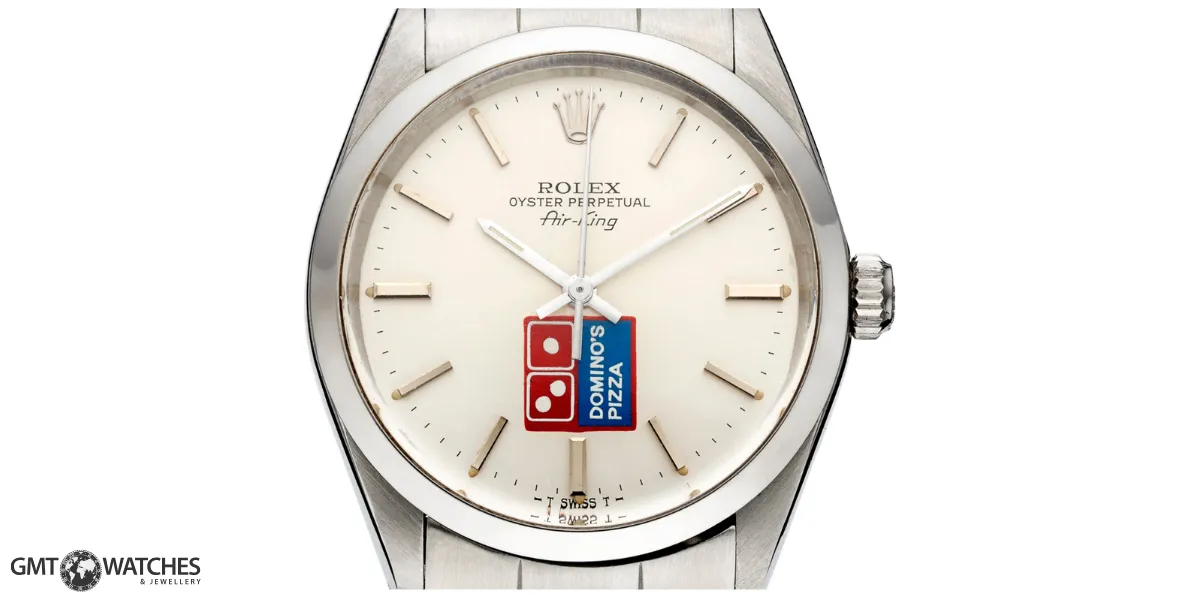
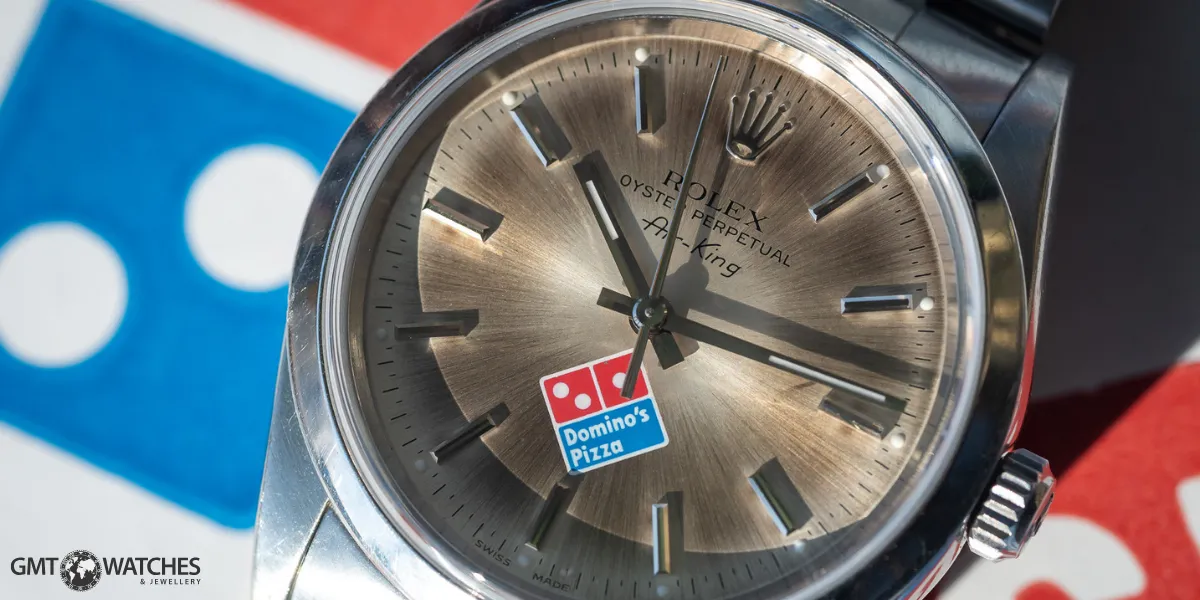
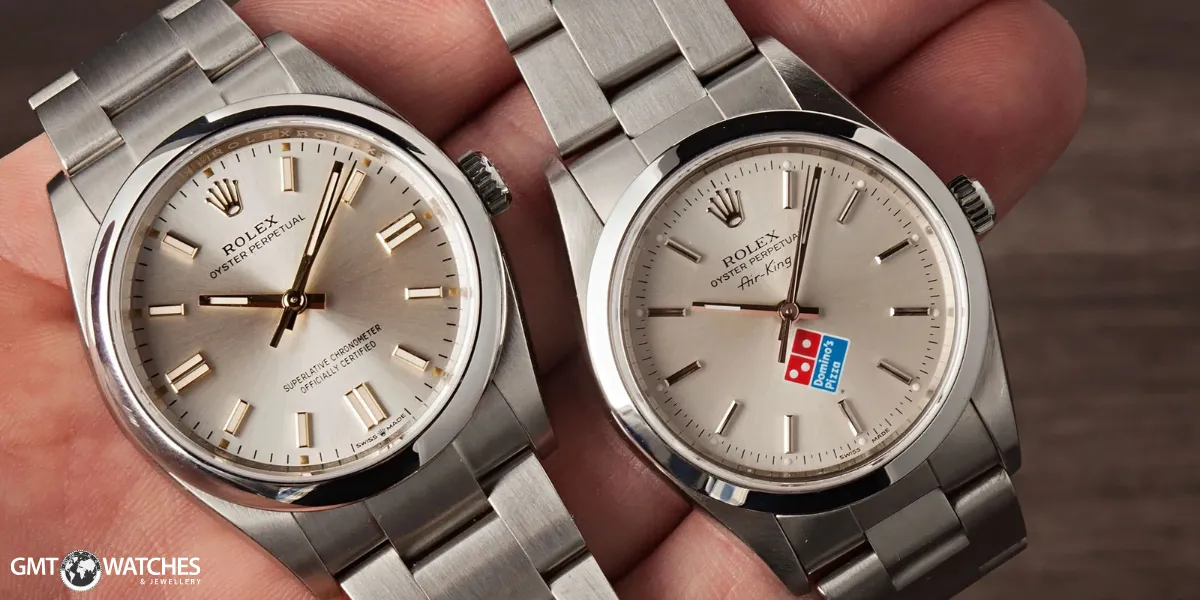
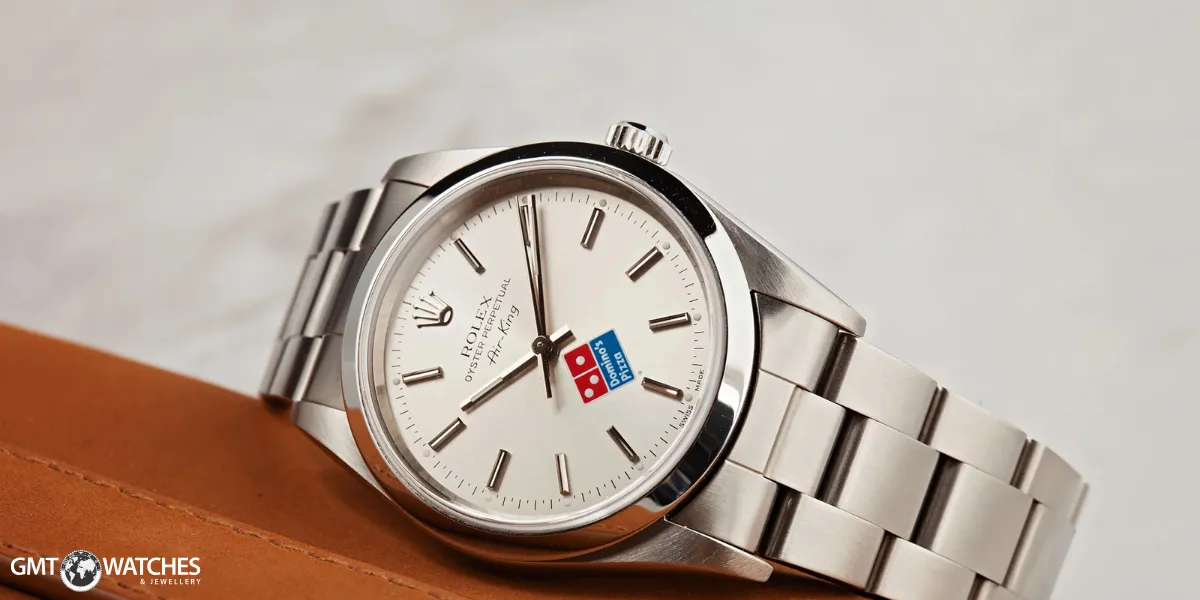
The earliest versions, most commonly found on the Rolex Air-King reference 5500, featured a large Domino’s logo placed prominently at 6 o’clock on the dial. Some also included engravings of the recipient’s initials and Tom Monaghan’s own initials “TSM” on the caseback. These bold designs left no doubt about the watch’s origin and purpose.
The Refined Logo Era (Early 1990s)
In the next phase, the Domino’s logo was reduced in size, still positioned at 6 o’clock but more subtle in its presence. This smaller logo made the watch a bit more versatile for daily wear while still retaining its distinctive identity.
The Tilted Logo Era (Mid-1990s)
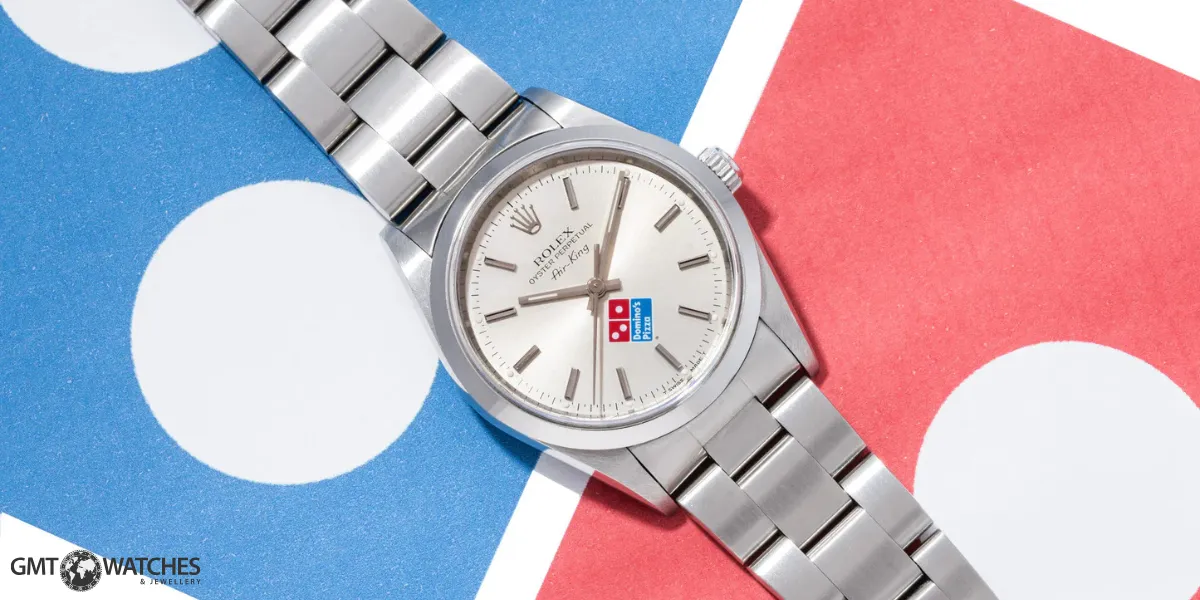
One of the most beloved versions among collectors came in the mid-1990s, often seen on Air-King references 14000 and 14000M. Here, the Domino’s logo was placed at a slight diagonal, giving the watch a playful yet sophisticated look. This tilted design became something of a cult favorite in the collecting community.
From Dial to Bracelet
By the 2000s, Rolex and Domino’s shifted the branding away from the dial itself, opting instead to place the Domino’s logo on the bracelet or caseback. This made the branding more discreet while still preserving the watch’s unique story. In many cases, the link closest to the clasp bore a small enamel Domino’s logo, which could be worn discreetly or shown off depending on the wearer’s preference.
This subtle approach reflected a broader change in corporate gift culture, where overt branding on luxury items became less common. Yet, even with this toned-down aesthetic, the Domino’s Rolex remained a symbol of achievement within the company.
The Domino’s Rolex Appeal for Collectors
For many years, the Domino’s Rolex was seen as something of a curiosity in the watch world. Some recipients even had the branded dials replaced with standard Rolex dials to make them more neutral for resale. Ironically, that practice has made original, untouched examples much rarer — and therefore far more valuable today.
Collectors are drawn to these watches for several reasons. First, they’re genuine Rolex timepieces with all the quality, durability, and precision that entails. Second, they carry a fascinating backstory that blends luxury goods with corporate history. Third, their relative scarcity — especially in earlier logo designs — makes them highly desirable in a market where unusual provenance can command significant premiums.
Today, examples of Domino’s Rolex watches in good condition can fetch prices well above standard Air-King or Oyster Perpetual models from the same era. In part, this is because they appeal not only to Rolex collectors but also to fans of pop culture, branding, and the history of American business.
Models Beyond the Air-King
While the Air-King was the most common base model for Domino’s Rolex pieces, the program later expanded to include Oyster Perpetual models such as references 116000 and 126000. These more modern versions continued the tradition with bracelet or caseback logos, blending Rolex’s contemporary styling with a nod to the brand’s unusual collaboration.
Despite the brand partnership, Rolex never compromised on quality. Every Domino’s Rolex met the same rigorous standards for movement accuracy, water resistance, and build quality as any other watch that left the Geneva factory.


Why the Domino’s Rolex Matters?
The Domino’s Rolex occupies a unique place in horological history because it defies expectations. Rolex is a brand often associated with luxury, formality, and exclusivity. Domino’s, by contrast, is rooted in fast food, casual dining, and mass-market accessibility. Combining these two worlds creates an object that is both playful and prestigious — a tangible reminder that achievement can take many forms.
Moreover, the Domino’s Rolex highlights the versatility of Rolex’s design language. Even with a bold, colorful logo on the dial, the watch retains its classic proportions, clean lines, and timeless appeal. For many collectors, wearing a Domino’s Rolex is as much about embracing the story as it is about owning a piece of fine watchmaking.
Cultural Recognition
In recent years, the Domino’s Rolex has been embraced not only by watch collectors but also by figures in the fashion and streetwear worlds. It has appeared in editorial shoots, been worn by celebrities, and discussed on major watch blogs and forums. This cultural crossover has only added to its mystique and desirability.
The appeal lies in its juxtaposition — a serious, high-quality timepiece that doesn’t take itself too seriously. In a world where branding is everywhere, the Domino’s Rolex stands out because its logo is not the result of a marketing gimmick for the public, but a reward for exceptional performance within a company.
A Slice of History You Can Wear
The Domino’s Rolex is more than a watch — it’s a story you can wear on your wrist. Each one tells a tale of ambition, competition, and the blending of two very different worlds. Whether you see it as a quirky collectible, a badge of achievement, or simply a conversation starter, there’s no denying its unique charm.
Owning a Domino’s Rolex is like holding a piece of corporate history and horological craft at the same time. It’s proof that sometimes, the most unexpected collaborations can create something truly memorable.
Also Read: Rolex Bubbleback Review