

When we talk about the legacy of Rolex, most people picture the Submariner, the Datejust, or the Daytona. But decades before these modern icons graced the wrists of celebrities and adventurers, Rolex made its name with a small, chunky watch that forever changed the course of horology—the Rolex Bubbleback.
This vintage model, produced between the early 1930s and the 1950s, is much more than a charming relic. It represents the convergence of two revolutionary innovations in Rolex watches: the waterproof Oyster case and the Perpetual automatic movement. Together, they laid the foundation for nearly every Rolex that came after.
In this article, we’ll explore the origin, evolution, mechanical innovation, collectability, and enduring charm of the Rolex Bubbleback.
The Birth of The Rolex Bubbleback
The story of the Bubbleback begins with two pivotal moments in Rolex history. First, in 1926, Rolex introduced the Oyster case, the world’s first truly waterproof wristwatch case. This was followed by the invention of the Perpetual rotor movement in 1931—an automatic winding system that powered the watch through wrist motion alone.
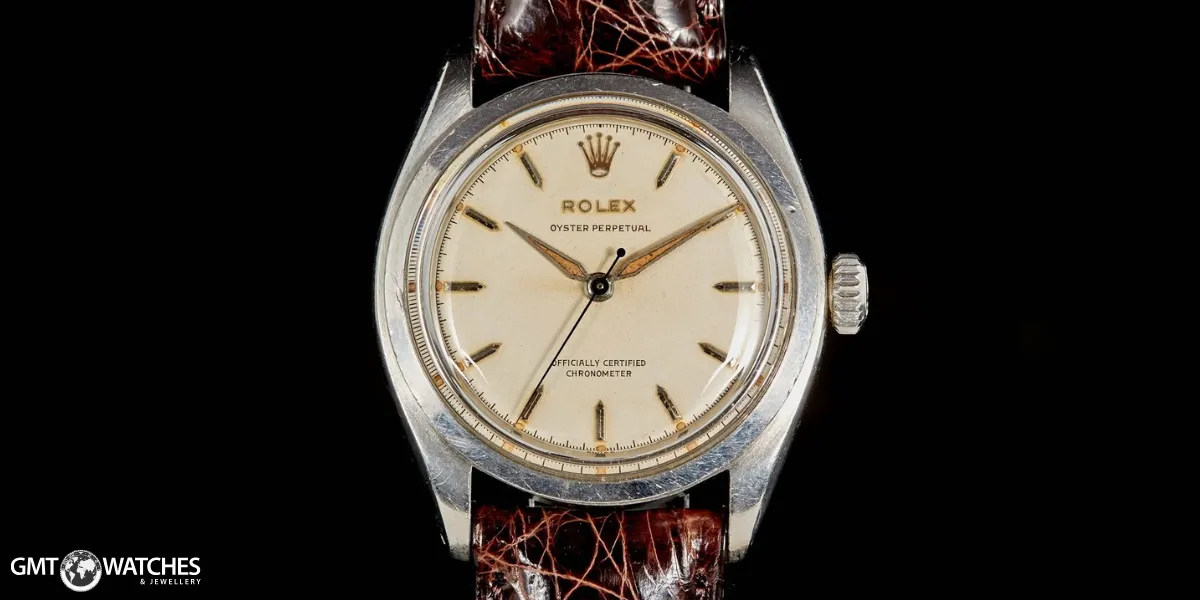
But this new self-winding movement was thicker than previous manual calibers. To accommodate it, Rolex had to bulge the caseback outward. The result? A distinctively domed back that gave birth to the affectionate nickname: Bubbleback. This seemingly odd design was more than a visual quirk—it was a technical necessity. And in solving that problem, Rolex inadvertently created one of its most iconic vintage case silhouettes.
| Bracelet | Launch Year | Link Count (20mm) | Weight (g, 40mm) | Material Options | Clasp Type |
|---|---|---|---|---|---|
| Oyster | 1948 | 84 | 78 | Steel, Gold, Two-Tone | Glidelock, Oysterclasp |
| Jubilee | 1945 | 112 | 82 | Steel, Gold, Two-Tone | Crownclasp, Oysterclasp |
| President | 1956 | 90 | 98 | Gold, Platinum | Crownclasp |
| Pearlmaster | 1992 | 88 | 105 | Gold, Platinum, Diamonds | Crownclasp |
| Oysterflex | 2015 | N/A (Strap) | 72 | Titanium-Nickel, Elastomer | Glidelock |
| Flat Jubilee | 2025 | 116 | 80 | Steel, Gold | Crownclasp |
Visual Features of Rolex Bubbleback Watches
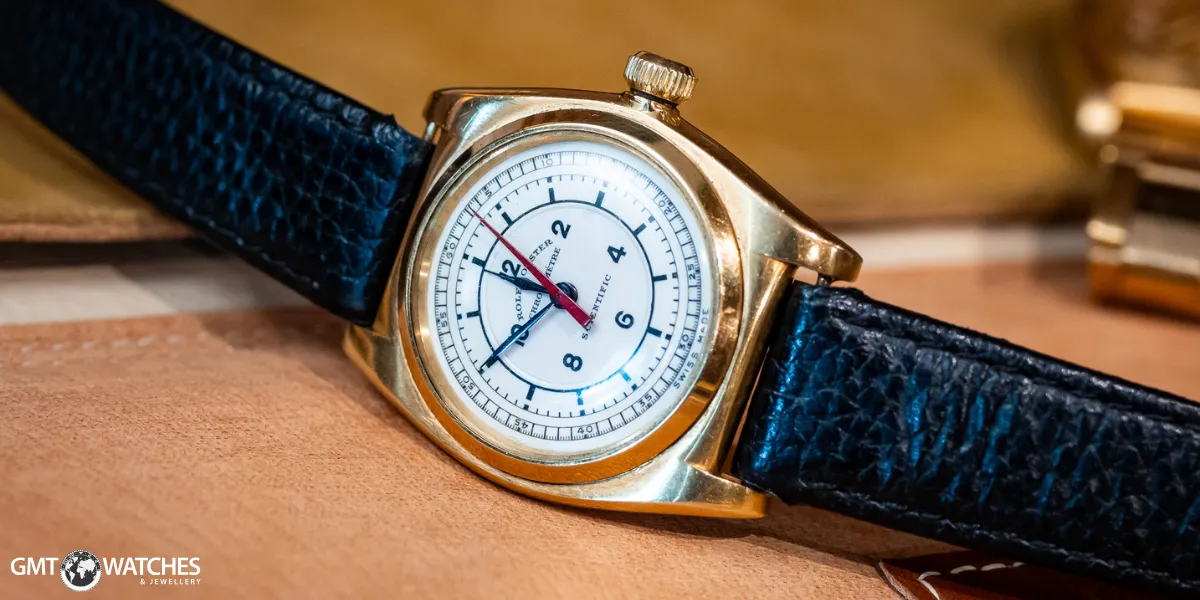
???? Rounded Case with Domed Caseback (Bubble-Shaped Back)
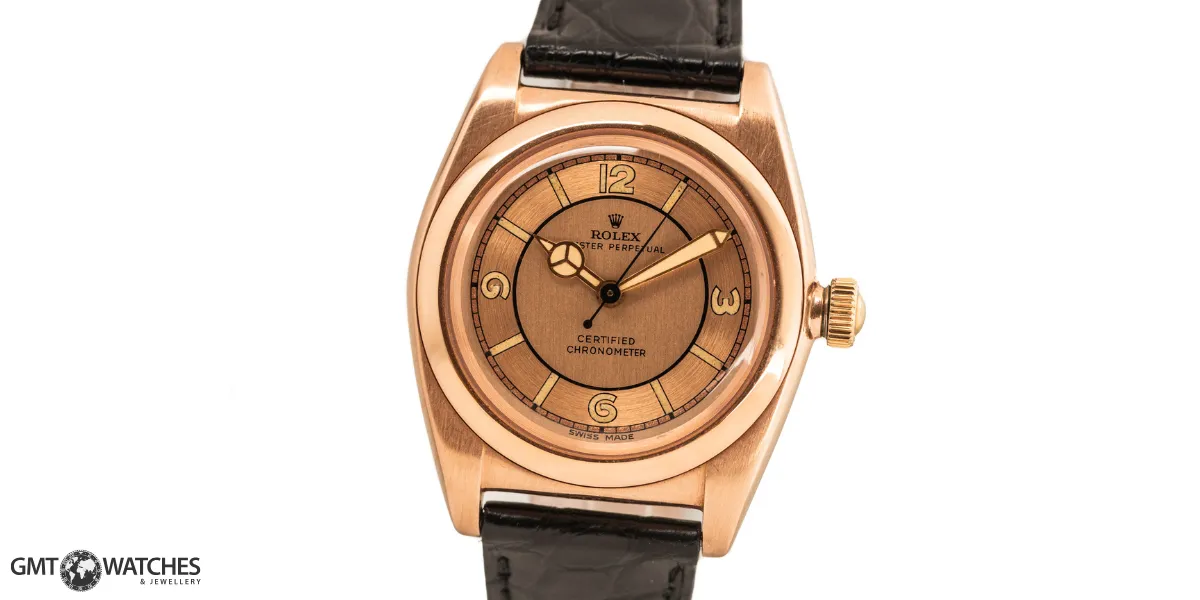
The most distinctive feature of the Rolex Bubbleback is its thick, domed caseback—resembling a bubble—which is where the nickname comes from. This bulging back was necessary to house the early automatic movement and gives the watch a bold, protruding wrist presence despite its small diameter.
???? Smaller Case Diameter (30–34 mm)
Bubbleback watches typically have a compact case size, ranging from 30 to 32 mm. Some later versions, known as “Big Bubblebacks,” reach up to 34 mm. While smaller than modern watches, their thickness and vintage charm make them appealing to both men and women today.
???? Noticeable Case Thickness
Due to the automatic rotor and domed caseback, Bubblebacks are much thicker than other vintage watches of their time. This added thickness gives them a sturdy, solid look on the wrist.
???? Domed Acrylic Crystal
The watches feature a convex (domed) acrylic crystal that complements the rounded shape of the case. While more prone to scratches than modern sapphire, it adds to the authentic vintage aesthetic.
???? Onion-Style Crown
Some Bubbleback models are equipped with an “onion-shaped” crown—rounded and oversized, making it easier to grip and adding a classic touch. Waterproof versions usually feature screw-down crowns with internal gaskets.
???? Slim Leather or Early Metal Bracelets
Originally, Bubblebacks were paired with narrow leather straps or early versions of Rolex’s Oyster or Jubilee metal bracelets. Strap widths typically range from 16 to 18 mm, proportionate to the smaller case.
???? Wide Variety of Dial Designs
Bubblebacks came in an impressive range of dial variations. Common features include:
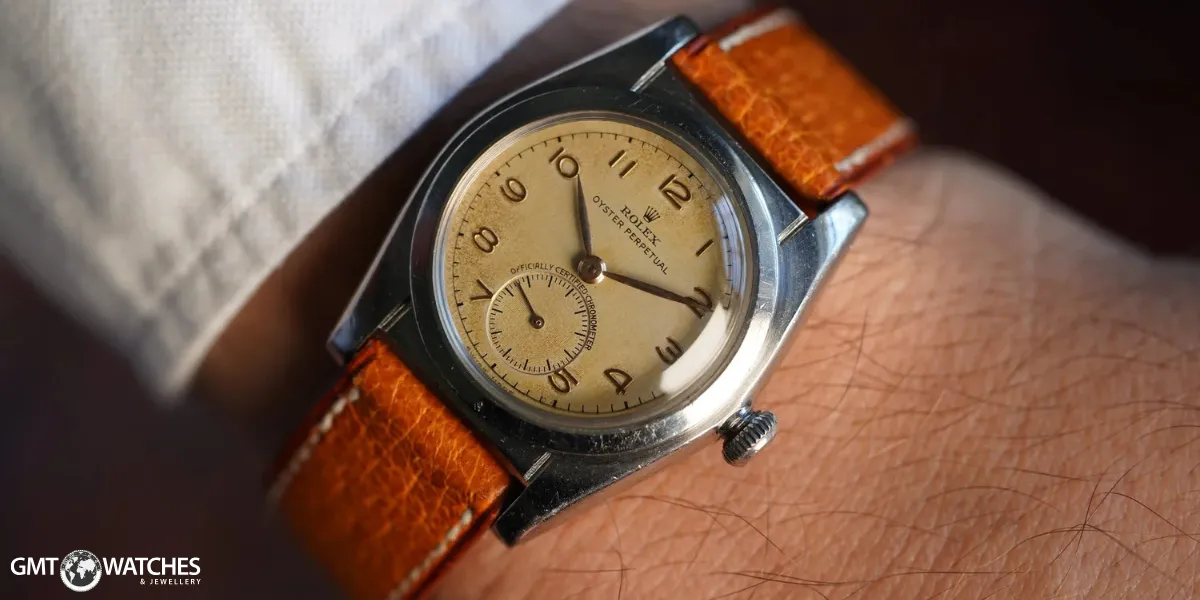
- Full Arabic or mixed Roman-Arabic (California) numerals
- Luminous markers with radium or tritium
- Leaf, sword, or dauphine-style hands
- Small seconds subdial at 6 o’clock on some models
???? Aged and Patinated Dial Colors
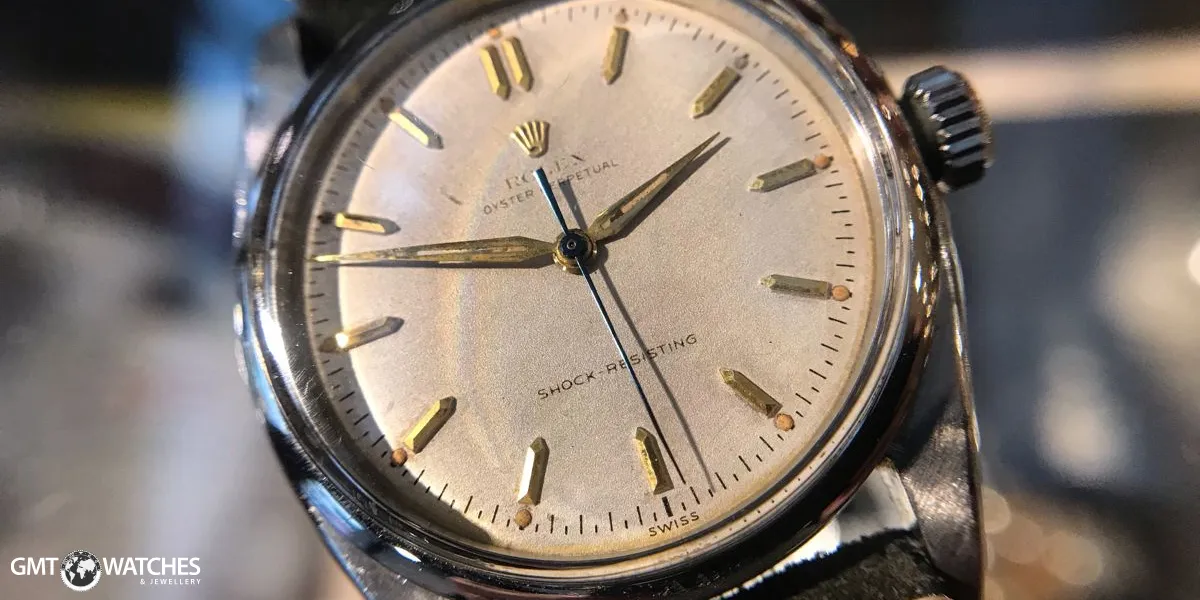
Many Bubbleback dials have naturally aged over the decades, developing unique patinas in shades of cream, amber, or brown. This patina is highly valued by collectors and gives each watch a one-of-a-kind vintage character.
Mechanical Brilliance Inside a Bulky Case
While the outward appearance of the Bubbleback is charming in its vintage proportions, the real marvel lies within. These watches housed Rolex’s earliest automatic movements, beginning with the Caliber 520 and evolving through the 600 and 700 series.
These calibers featured a full 360-degree rotor—a significant advancement at the time. Unlike earlier bumper automatics used by competitors like Omega and Jaeger-LeCoultre, Rolex’s rotor moved freely in both directions, ensuring smoother and more efficient winding.
Accuracy and reliability were at the heart of Rolex’s mission, and the Bubbleback delivered both in spades. It’s no exaggeration to say that Rolex’s claim to chronometer-grade performance was largely built on the back of the Bubbleback series.

More Than Just a “Bubble”
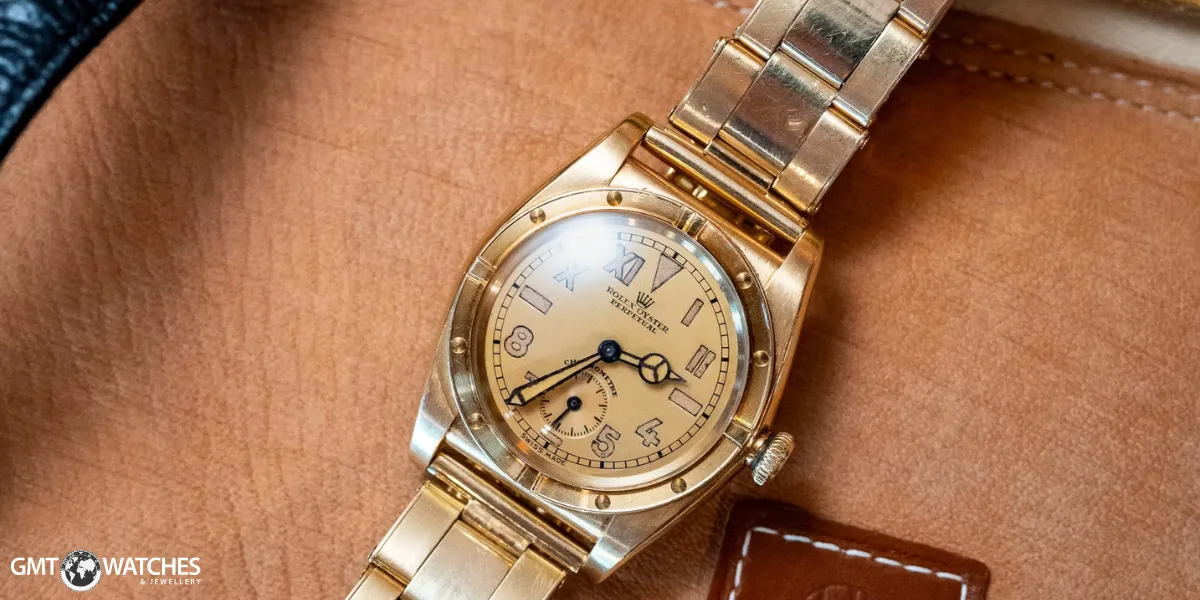
From a design standpoint, Bubblebacks are unmistakable. With a case size typically ranging from 30 to 34mm, they may seem small by today’s standards, but their thickness gives them a bold wrist presence. Later models, such as the so-called “Big Bubblebacks“, pushed closer to 34mm and are now especially sought after.
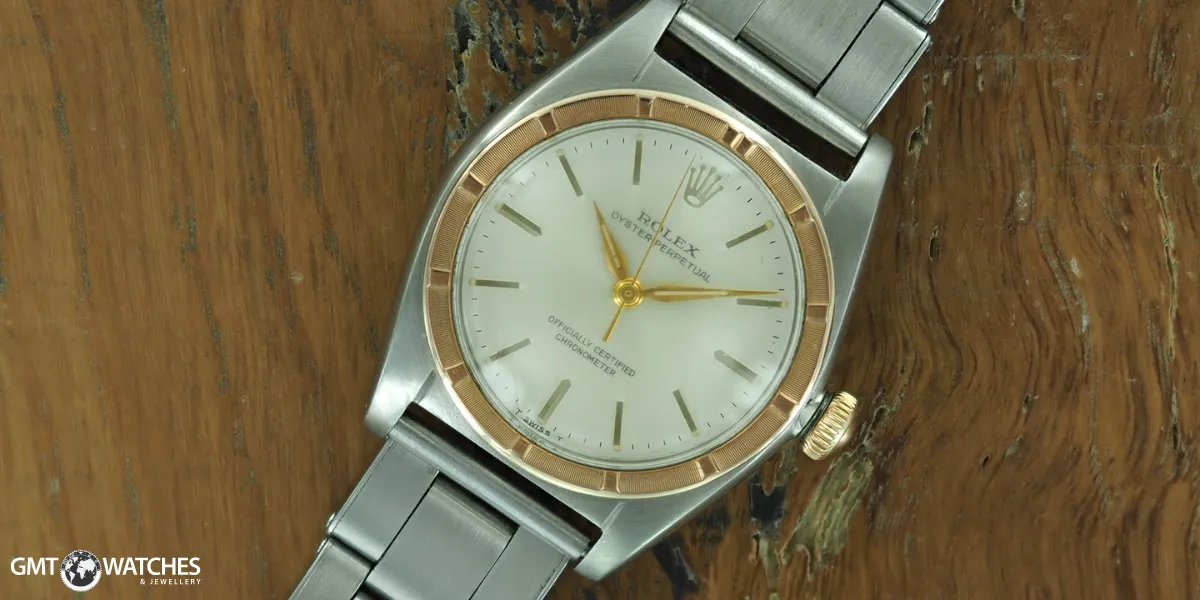
The watches came in a variety of case materials, including stainless steel, yellow gold (14k or 18k), pink (rose) gold, and two-tone steel and gold (Rolesor).
The dial options are just as diverse. Collectors particularly cherish models with California dials (half Roman, half Arabic numerals), sector dials, and those with original radium lume still intact.
Some references came with engine-turned bezels, while others featured smooth polished finishes. The variety and charm of these early dials give each piece a character all its own—no two Bubblebacks age exactly the same.
Notable References and Variants
Several references in the Bubbleback family stand out for their unique characteristics or historical relevance. Among them:
▶ Ref. 3131: A classic gold Bubbleback from the 1940s, often featuring simple dial layouts and attractive patina.
▶ Ref. 2940: One of the earliest and thickest Bubblebacks, showing the exaggerated domed caseback clearly.
▶ Ref. 6085: A “Big Bubbleback” with a more modern feel, often used as a transitional design toward what would become the Datejust.
Many Bubblebacks were unisex in their time, but today, men and women alike appreciate their vintage charm and wearability.
Why Collectors Love The Rolex Bubbleback?
In the 1980s and 1990s, Rolex Bubblebacks were considered among the most desirable vintage watches, especially in Asia and Italy. Their prices even rivaled—and sometimes exceeded—those of steel Daytonas at the time.
Although the hype cooled in the early 2000s, there’s been a noticeable resurgence of interest in recent years. Why? For one, collectors are increasingly valuing historical significance, and few models can match the Bubbleback in that regard. It’s a living artifact of Rolex’s earliest engineering triumphs.
Secondly, the vintage watch community has embraced smaller case sizes again. What was once dismissed as “too small” is now celebrated for its elegance and proportional balance.
Most importantly, no two Bubblebacks age the same way. Whether it’s the patina on the dial, the warmth of the gold case, or the soft fading of vintage lume, each piece tells a story. For collectors of Rolex watch men styles, that uniqueness makes owning a Bubbleback feel incredibly personal.

Things to Consider When Buying a Bubbleback
If you’re considering adding a Bubbleback to your collection, here are a few expert tips:
✔ Dial Originality: The value of a Bubbleback heavily depends on the originality of the dial. Many older examples have been repainted or refinished. Look for even aging, correct fonts, and period-appropriate lume.
✔ Movement Integrity: Due to their age, many Bubblebacks have undergone repairs or part replacements. Ideally, you want one with matching serial numbers, original rotor, and components intact.
✔ Case Condition: Over-polishing can ruin the appeal of a vintage Rolex. Sharp lugs and unpolished edges are a good sign of a well-preserved case.
✔ Service History: These watches are 70+ years old and require specialized care. Ensure the movement is running well, and if you’re planning to wear it regularly, consider having it serviced by a trusted vintage specialist.
Rolex Bubbleback in Today’s Market
The current vintage market has rediscovered the Bubbleback. While prices vary depending on condition, rarity, and reference, you can still find well-preserved examples between $4,000 and $12,000. Rare references, original California dials, or gold models in excellent condition can command significantly higher figures.
Auction houses and vintage dealers report steady demand for clean, untouched examples. And as vintage Rolex collecting becomes more refined and research-driven, Bubblebacks are being re-evaluated not just as entry-level vintage pieces—but as foundational Rolex milestones.
The Rolex Bubbleback’s Legacy
The Rolex Bubbleback is more than just a quirky vintage model—it is Rolex’s first real success story. It bridged the gap between pocket watches and modern wristwatches, between manual winding and perpetual motion. It made the case—literally and figuratively—for waterproof, automatic watches at a time when few believed they were possible.
Without the Bubbleback, there would be no Oyster Perpetual, no Datejust, and arguably, no Rolex as we know it today.
So, whether you’re a seasoned collector or just stepping into the world of vintage watches, the Bubbleback is a treasure worth appreciating. It’s a reminder that sometimes, the most important innovations come in small, domed packages.
Also Read: Top 6 Most Beautiful Rolex Bracelets Ever Made
FAQ – Rolex Bubbleback